Perioperative Guidelines
As perioperative guidelines seem to update every five minutes, a list of the important ones may be useful for preparation of your patients for private surgery.

Diabetes Type I
T1DM patients are usually very insightful regarding their disease management. Those on a pump should normally continue with the pump at its pre-programmed rate.
Others will usually be on a glargine type long-acting insulin and peri-prandial short-acting insulin such as aspartate or novorapid. The glargine should be continued and the short-acting insulin withheld for whatever meals are skipped, but the patient should check their BGL and give themselves short-acting insulin (or a sugar source) if required.
Diabetes Type II
Whether an oral hypoglycaemic drug (OHGD) should be withheld depends on its mode of action. Traditionally all OHGDs have been withheld on the day of surgery, even for day surgery. With the ongoing discussions over guidelines for SGLT2 inhibitors, many have reviewed such generalised guidelines with a view to individualising care.
Biguanides (of which metformin is the only one in common use) have as their principal action a decrease in hepatic gluconeogenesis. They also increases peripheral sensitivity to insulin. Metformin does not present a risk for hypoglycaemia if taken while fasting.
For day surgery and other surgery without post-operative fasting, metformin should be continued, even on the morning of surgery. If a patient is expected to be fasting post-operatively, then it should be withheld, as the risk of lactate accumulation increases due to metformin’s reduction in hepatic mitochondrial oxidative phosphorylation (by which it decreases gluconeogenesis).
If renal dysfunction has occurred perioperatively, it should be restarted after 24h with stabilisation of renal function.
The “gliptins”
Dipeptidylpeptidase-4 inhibitors inhibit degradation of glucagon-like peptide 1 (GLP-1). Examples include: linagliptin (Trajenta), saxagliptin (Onglyza), and sitagliptin (Januvia). These may be combined with other drugs such as SGLT2i or metformin (such as Janumet or Trajentamet).
Such DPP-4 inhibitors also do not present a risk for hypoglycaemia and should be continued on the day of surgery unless combined with an SGLT2i.
Alpha-glucosidase inhibitors
Acarbose inhibits intestinal glucose absorption.
Omit on the morning of surgery if a meal is skipped and restart once food intake is resumed.
Sulfonylureas
Gliclazide (diamicron, glyade), glimepiride (amaryl). These drugs increase insulin secretion and should be withheld on the morning of surgery and restarted once food intake has resumed.
They present a risk for hypoglycaemia if taken while fasting.
Thiazolidinediones
Pioglitazone (Actos) enhance insulin sensitivity and do not present a risk for hypoglycaemia. If taken alone, they need not be withheld perioperatively. It may be combined with metformin (Actoplus Met) or with gliclazide (Duetact).
In the latter case, such combined medications should be withheld on the day of surgery and resumed with feeding.
Meglitinides
Repaglinide (NovoNorm) stimulates insulin secretion and should therefore be withheld on the day of surgery and continued with feeding.
Sodium Glucose Co-Transporter-2 inhibitors
(SGLT2i) – “the flozins”: These drugs decrease BGL by inhibiting renal glucose reabsorption. They do this so well and with sufficient duration of action that although they do not present a significant risk of hypoglycaemia if taken while fasting, are nevertheless effective in causing insulin levels to stay very low, inducing ketone production, as well as dehydration and high levels of counter-regulating hormones glucagon, cortisol and adrenaline. The risk of euglycaemic ketoacidosis for fasting patients is significant. If SLGT2i have not been stopped and blood ketones are >0.6mmol/L then postponement of surgery should be considered, pending an ABG/VBG to determine pH. All cases of euglycaemic DKA should be managed with endocrine consultation and sent to HDU.
Current guidelines from the ANZCA and Australian Diabetes Society are:
• Day surgery: withhold on day of surgery and recommence on feeding.
• Day of surgery admission for overnight stay: withhold SGLT2i for THREE days including the day of surgery and recommence with feeding
• Colonoscopy or other procedures with bowel prep: withhold SGLT2i for FOUR days including the day of surgery and recommence with feeding
For the three and four-day withholding cases, thought should be given to glycaemic control for such a long period. I write the patient a script for metformin 500mg BD for the days spent off the SGLT2i. If they are taking combined medications like Glyxambi, Jardiamet, Xigduo, Qtern, Synjardy, then the metformin therein should be prescribed individually, perhaps at an increased dose of 1000mg BD rather than the 500mg contained in the combined tablet.
GLP-1 Injectables
GLP-1 agonists such as exenatide (Byetta), semaglutide (Ozempic, Wegovy, or Mounjaro), dulaglutide (Trulicity) would be continued as far as glycaemic control goes, but they do slow gastric emptying.
Case reports have emerged recently of patients refluxing and aspirating on induction following the mania for Ozempic currently underway.
Thought should be given to prolonging solid food fasting times for patients on GLP-1 agonists who also have other risk factors for reflux such as hiatus hernia, gastric band etc as well as delaying GLP1 agonist doses until after surgery if the dose falls close to the day of surgery.
Direct (or Novel) Acting Anti-coagulants (DOAC/NOAC)
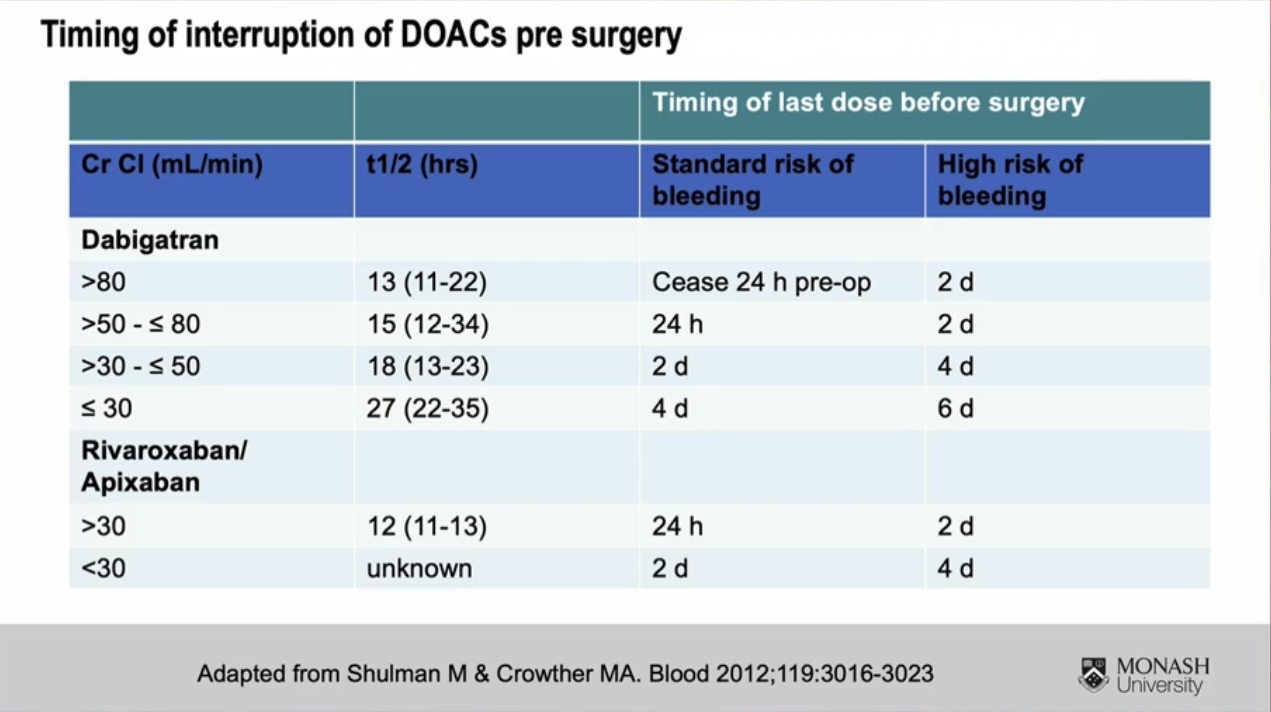
The chief advantage of the drugs apixaban and rivaroxaban (direct Factor Xa inhibitors) and dabigatran (direct thrombin inhibitor) is that they may be taken close to surgery and do not require any bridging with LMWH or unfractionated heparin.
The following constitutes the accepted guidelines for cessation periods of all three drugs, taking into account bleeding risk, thrombus risk and renal function:
Warfarin
If the patient is taking warfarin for Atrial Fibrillation and has not had a stroke or PE, they may cease warfarin for FIVE days without clexane/heparin bridging.
If they are taking it for AF and have had a thrombosis, they should take their last dose of warfarin SEVEN DAYS before surgery, then on DAYS 5-1 pre-op inject CLEXANE ONCE DAILY 1.5mg/kg of their lean or ideal weight. Since it is impractical to obtain a DEXA or Bioelectric impedance analysis to estimate lean weight, I just multiply the square of their height in metres by 22.5, representing what their weight would be if their BMI were 22.5.
I also use the 1.5mg/kg OD regime if they are on warfarin for past PE without a known provocation.
If they are on warfarin for a non-biological heart valve prosthesis or any other non-biological prosthesis, the same timing applies, but the dose is TWICE DAILY at 1mg/kg ideal weight, with the last dose being the morning before the day for morning surgery, or the evening before for afternoon surgery.
Patients with frequent PE such as homozygous Factor V Leiden would also usually be on the BD dose.
Please refer more complicated patients on anticoagulants to a haematologist or to me and if it requires specialist input, I will arrange for haematology advice.
.png)

.png)
 02 8795 0892
 info@michaelayling.com.au