First things first – what sedation is and what it is not.
Sedation for dental and other minor procedures is intended to make the procedure more comfortable and tolerable. Technically, this technique is known as Conscious sedation. Sometimes this is known as "twilight sedation". The primary purpose is to make you comfortable and to minimise any memory you may have of the procedure.
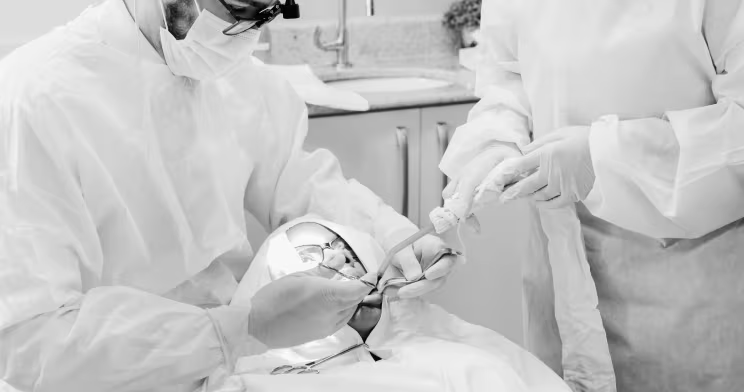
Conscious sedation is not general anaesthetic.
While medications that reduce memory are used, this is not the same as a deep general anaesthetic that you might have in a hospital. The differences are that you protect your own airway reflexes (you are not paralysed and you will not have airway tubes in your breathing tract), you can obey simple instructions, you may have some memory of the procedure.
Under dental sedation, the procedure will seem like a dream state and you are not very likely to remember much at all, especially at the beginning of the case. Sometimes it feels as if you remember more than you actually do. Each patient's experience is unique.
Safety precautions:
Your safety is Dr Ayling’s primary concern. For some patients, dental sedation in-rooms carries unacceptable risk, so screening questions will be asked and if those risks exist, then in-rooms sedation will be declined.
These risk factors include Body Mass Index (BMI) above 40, sleep apnoea, severe lung or pulmonary disease such as COPD, heart failure, severe dementia, severe claustrophobia, or other condition which precludes lying flat for up to 3 hours.
Credentials and safety equipment
Dr Ayling is a specialist consultant anaesthetist and Fellow of the Australian and New Zealand College of Anaesthetists. Dr Ayling consults in teaching hospitals in South West Sydney as well as in the private sector. Specialist anaesthesia training in Australia involves extensive postgraduate medical training through ANZCA.
Whereas simple sedation can be given by any doctor, should you encounter any difficulty with your breathing, airway, or other medical complication, your anaesthetist is trained, experienced and equipped to deal with serious complications, including advanced airway management and advanced life support.
Preparing for your dental sedation experience
For instructions on preparation for your dental procedure, please click
here.png)

.png)
 02 8795 0892
 info@michaelayling.com.au